Sealing Glass for SOFC

Designed for CTE-Matched
SOFC Metal-to-Ceramic Sealing
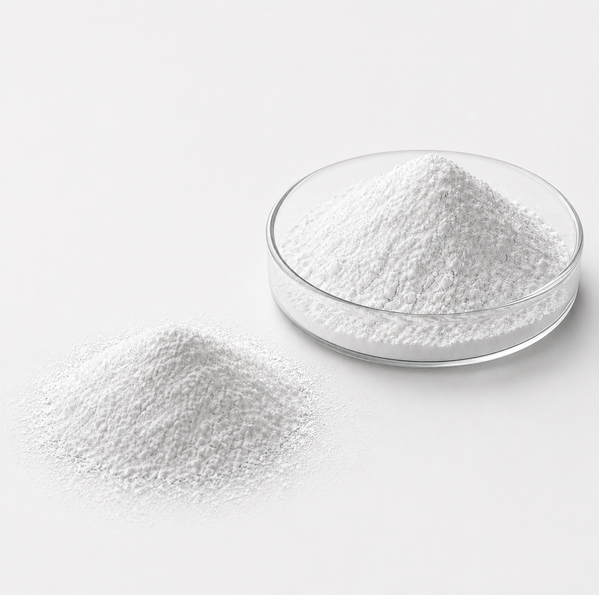

Sealing Glass for SOFC
Sealing Glass for SOFC |
|
| Parameter | Specification |
| General Properties | |
|
Product Code |
SF002 |
|
Color |
White |
|
Supply Form |
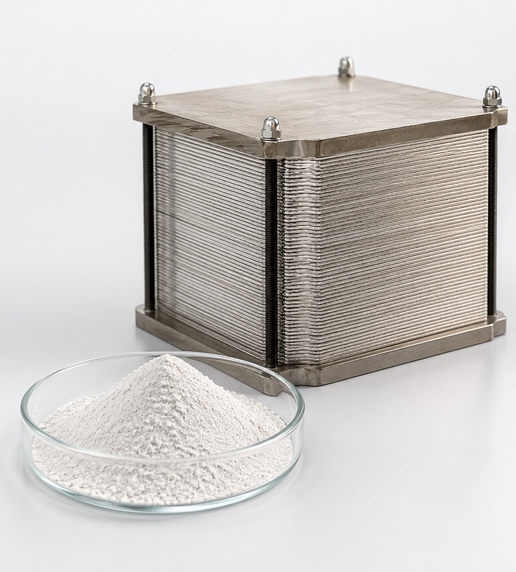
Glass Powder |
|
Density |
3.74 ± 0.06 g/cm³ |
|
Particle Size (D50) |
7–10 μm |
|
Particle Size (D97) |
38–48 μm |
| Thermal Properties |
|
|
Glass Transition Temperature (Tg) |
600 ± 5°C |
|
Softening Point |
640 ± 10°C |
|
Working Point |
650–750°C |
|
Recommended Sealing Temperature |
750–800°C |
| Thermal Expansion |
|
|
CTE — Glassy State (20–300°C) |
10.8 ± 0.6 × 10⁻⁶/K |
|
CTE — Crystallized State (20–300°C) |
11.07 ± 0.6 × 10⁻⁶/K |
|
Developed primarily for SOFC sealing, SF002 can also be used for SOEC applications. CTE and formulation adjustments are available for specific sealing requirements. |
|
Applications & Processing
-
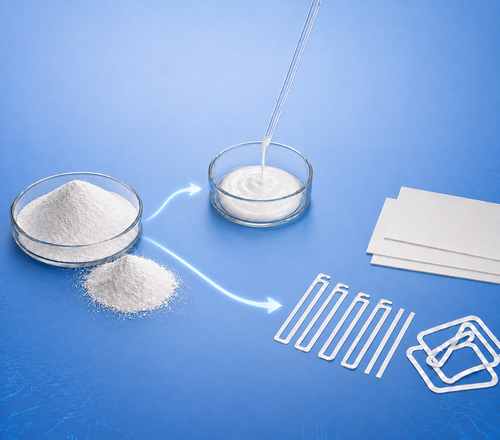
Glass Powder Processing
-
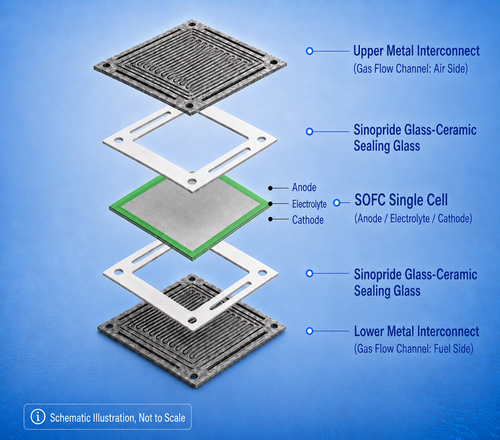
SOFC Cell-to-Interconnect Sealing
-
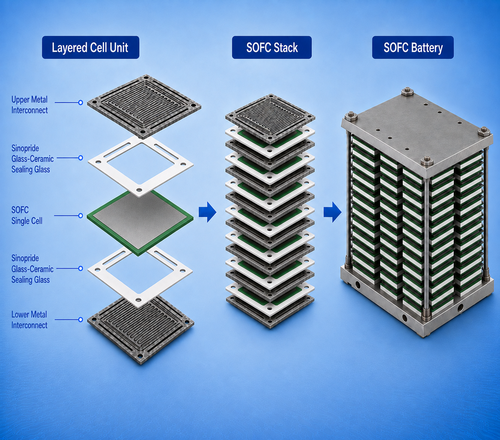
SOFC Stack Assembly

CTE Matching & Adjustment

Crystallizable Glass-Ceramic Structure

Evaluated with 430/441 SS & YSZ

Custom Formulation Support
Crystallizable Glass-Ceramic Design
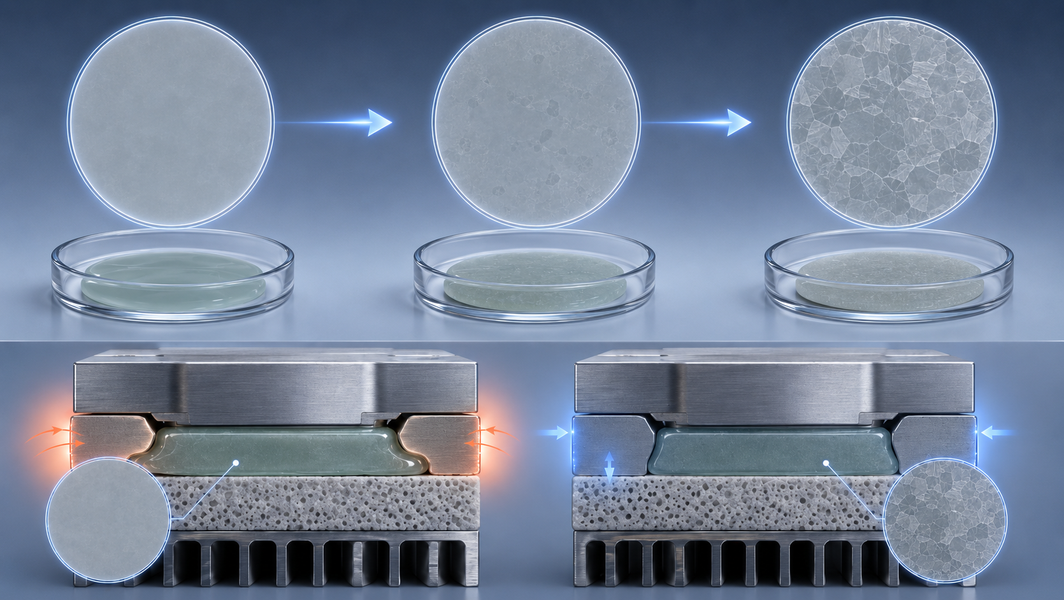

SF002 is designed as a crystallizable glass system. During the initial sealing stage, the glass softens at a relatively low temperature and develops sufficient flow to fill the sealing area and establish good contact with the adjoining materials, thereby forming the initial seal. As the sealing and subsequent heat-treatment process continues, crystallization takes place and a stable glass-ceramic structure develops. This transformation significantly improves the high-temperature stability of the sealing material. As the operating temperature increases, the crystallized seal is less susceptible to further softening and viscous flow, allowing it to maintain structural integrity and reliable sealing performance during long-term high-temperature SOFC operation.
Crystallization allows SF002 to combine the flow required during sealing with high-temperature stability after sealing. The glass first softens and flows to fill the sealing area, then develops stable crystalline phases that improve structural stability at elevated temperature. If crystallization occurs too early or too rapidly, viscosity may increase before sufficient flow and wetting are achieved. Insufficient crystallization, however, may reduce long-term high-temperature stability. Therefore, softening, flow, and crystallization must be properly balanced.
SOFCs operate at elevated temperatures. During startup, the stack is heated from a lower temperature to its operating temperature, while shutdown causes it to cool again. Over long-term use, repeated startup and shutdown cycles expose the stack to repeated heating and cooling, resulting in thermal cycling. The stack contains metallic interconnects, ceramic components, and sealing glass, all of which expand and contract at different rates as temperature changes. If their coefficients of thermal expansion are poorly matched, thermal stress can develop at the sealing interface. Repeated thermal cycling may then lead to microcracking or interfacial cracking, which can compromise gas tightness and long-term sealing reliability.
Sealing paste is well suited to dispensing, screen printing, and other localized deposition methods, offering greater flexibility for different sealing paths and more complex geometries. Tape-cast green sheets can be pre-cut to the required shape, with seal thickness controlled by sheet thickness or stacking. They are particularly suitable for regular planar sealing areas where dimensional and thickness consistency are important.
The selection of an SOFC sealing glass should not be based on a single material property. It should be evaluated in combination with the stack material system, sealing process, and actual operating conditions. Key factors typically include the coefficients of thermal expansion of the metallic interconnect and ceramic components, sealing temperature, operating temperature and high-temperature stability, thermal cycling conditions, seal design and processing method, as well as gas-tightness requirements.
Product